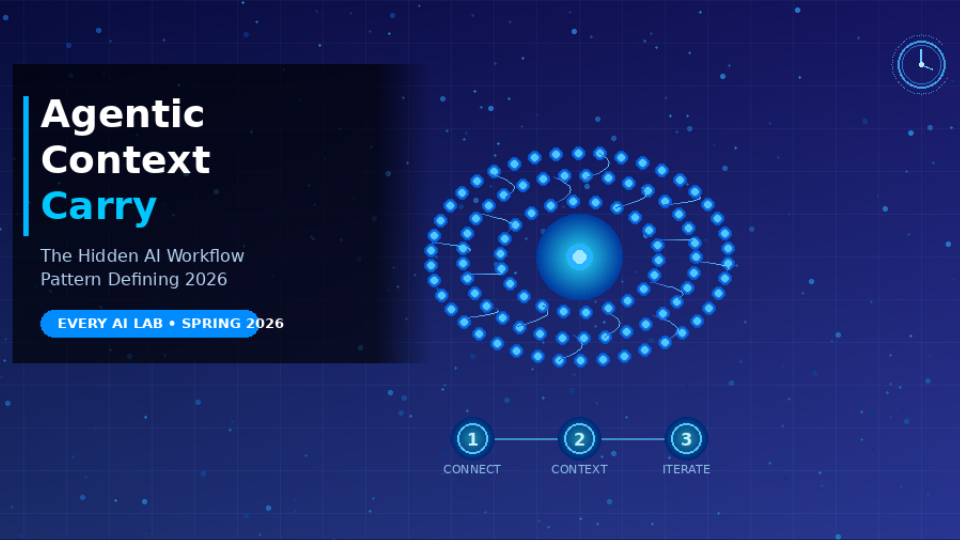
Every major AI lab just shipped scheduled agents this spring. Here’s why the real breakthrough isn’t the scheduling — it’s what the agents remember between runs.
In the past twenty-four hours, both OpenAI and Google have released updated versions of their drag-and-drop agent builders — visual tools that let enterprise teams wire together AI workflows that operate with their context around the clock. OpenAI’s Workspace Agents, powered by its Codex engine, launched on April 22 with the promise of Codex-powered agents that “keep working even when you’re not.” One day earlier, Google used its Cloud Next 2026 keynote to rebrand Vertex AI as the Gemini Enterprise Agent Platform and debut Workspace Studio, a no-code agent builder for Google Workspace. These aren’t isolated product drops. They are the crescendo of a spring 2026 wave in which Anthropic, OpenAI, Microsoft, Google, and Perplexity all shipped scheduled, autonomous agent capabilities within weeks of each other.
In AI, there has always been a useful distinction between features and benefits. The feature is that large language models are smarter and faster than humans at many cognitive tasks when used correctly. The benefit has been productivity — faster drafts, quicker code, more efficient research. But over the past two months, the feature side has exploded. Context windows have ballooned to one million tokens. Agents now run persistently in the cloud. App integrations number in the dozens. Yet the benefit side — the tangible, compounding value these tools deliver to organizations — is still being written. Most teams are still using AI the way they used it in 2024: one prompt, one answer, one closed tab.
There is a new benefit paradigm hiding in plain sight. It doesn’t have an official name yet, which is part of why so few business leaders are talking about it. But understanding it now — and acting on it this quarter — may be one of the most important strategic investments a technology leader, operator, or founder can make in 2026. It sits at the intersection of scheduling, memory, and tool integration, and it fundamentally changes what an AI agent can become over time.
Scheduled Agentic Context Carry — A New Framework
Let’s give this pattern a working name: Scheduled Agentic Context Carry, or SACC. It describes the ability for AI agents to run on a defined schedule, carry persistent context — personal memory, company data, dynamic data pipelines, tool access — between runs, and accumulate institutional knowledge over time. Each of those words does specific work in the definition, and the combination is greater than the sum of its parts.
“Scheduled” means the agent wakes up on a cadence or in response to a trigger, not only when a human opens a chat window and types a prompt. It might fire every morning at 7:00 AM, every time a pull request is opened, or every time a specific type of email lands in an inbox. The agent is no longer reactive. It is proactive. “Context” refers to everything the agent carries into each session: your memory and preferences, your company’s documents and data, your tool authorizations, your conversation history. This is the informational substrate that transforms a generic language model into something that understands your business. “Carry” is the key innovation. The agent doesn’t start from zero each time it runs. It retains what it learned in previous sessions, builds upon prior analysis, and refines its understanding of your workflows with each execution cycle.
Why does this matter so much? Because SACC represents the practical stepping stone between reactive chatbots and fully autonomous AI agents. The industry has spent the past year talking about autonomy as though it’s a binary: either the AI waits for your prompt, or it runs your entire business unsupervised. In reality, there is an enormous and commercially valuable middle ground. We are not yet at true autonomous general agents that can safely execute complex, open-ended goals without human oversight. The failure modes are too unpredictable, the guardrails too immature, the liability questions too unresolved. SACC is the architecture that lets organizations capture most of the value of autonomy — compounding knowledge, proactive execution, cross-system coordination — while maintaining the human checkpoints that enterprise governance demands.
Think of it this way: a chatbot is a calculator. A scheduled agent with context carry is a junior analyst who shows up every morning, remembers everything from yesterday, and gets slightly better at their job each week.
The Competitive Landscape: Who Shipped What
The timing of this spring’s launches is not coincidental. Every major AI lab appears to have arrived at the same conclusion — that the next commercial unlock for AI is not smarter models but more persistent ones — and they all moved within the same narrow window. The competitive dynamics tell a story of convergence that should command attention.
Anthropic fired first. On April 14, the company launched Claude Code Routines in research preview, bringing automated scheduled agent runs to its cloud infrastructure. A routine is a saved configuration — a prompt, one or more GitHub repositories, and a set of connectors (Slack, Linear, Gmail, and others) — that executes autonomously on Anthropic-managed infrastructure. Routines can be triggered by time-based schedules (hourly, daily, weekly), by GitHub webhook events such as a new pull request, or by HTTP API calls from external systems. Critically, Claude Code operates with a one-million-token context window by default, giving it enough working memory to hold weeks of accumulated project context in a single session. Early adopters are using routines for nightly backlog grooming, automated PR review, docs-drift detection, and alert triage — tasks that previously required either dedicated human attention or brittle cron jobs that couldn’t adapt when something unexpected happened.
OpenAI responded eight days later with Workspace Agents in ChatGPT, available April 22. Powered by the Codex engine, these agents represent what the company calls “an evolution of GPTs” — but the leap is substantial. Workspace Agents run in the cloud, maintain persistent memory across sessions, connect to more than twenty third-party applications including Slack, Salesforce, and Google Drive, and can be set to run on a schedule or respond to defined triggers. The setup process is designed to be accessible: describe a recurring workflow, and ChatGPT maps the process, connects the required tools, tests the agent, and lets you activate it. OpenAI’s GPT-5.4 model, released in early March, supports up to one million tokens of context through the API, enabling the kind of long-horizon planning and execution that makes scheduled context carry technically viable. The company now reports nine million paying business users and Codex adoption growing sixfold since January.
Microsoft entered the arena on March 9 with Copilot Cowork, the centerpiece of its Wave 3 Microsoft 365 Copilot platform update. In a move that raised eyebrows across the industry, Microsoft built its newest flagship M365 feature not on OpenAI’s technology — despite a thirteen-billion-dollar investment in that partnership — but on Anthropic’s Claude, leveraging a separate thirty-billion-dollar Azure compute deal. Copilot Cowork runs in the cloud inside Microsoft 365’s infrastructure, accesses the full graph of a user’s enterprise work data (Outlook, Teams, SharePoint, Excel), and can manage workflows spanning multiple data sources over extended periods. CEO Satya Nadella described it as moving Copilot from chat to action. Google, meanwhile, used its Cloud Next 2026 keynote on April 22 to unveil the renamed Gemini Enterprise Agent Platform with Workspace Studio, a no-code agent builder, plus managed MCP servers, the production-grade Agent-to-Agent (A2A) protocol at 150 organizations, and Project Mariner for web-browsing agents. Google Cloud chief Thomas Kurian explicitly framed the strategy as “owning the full stack from chip to inbox.” And Perplexity, the AI search company valued at twenty billion dollars, launched its Computer platform in late February — a multi-model orchestration engine that can run persistent, long-duration workflows across nineteen AI models, with sub-agents delegated to specialized tasks and memory retained across sessions.
One pattern worth noting: the open-source agent movement that surged in February and March 2026 — with frameworks for local agent orchestration, MCP server ecosystems reaching ten thousand servers and ninety-seven million monthly SDK downloads — may have accelerated the major labs’ timelines. When the open-source community demonstrated that persistent, tool-using agents were technically feasible without proprietary infrastructure, the commercial labs appear to have fast-tracked their own managed offerings. The result is an arms race with a clear through-line: the future belongs to agents that remember.
Why Context Windows Changed Everything
To understand why scheduled context carry is happening now rather than a year ago, you have to understand the technical breakthrough that made it possible: the radical expansion of context windows. In 2025, the free tier of most consumer AI chatbots offered roughly 8,000 tokens of context — approximately 6,000 words of combined input and conversation history. That’s less than a single long business memo. The model could process what was immediately in front of it, but it had no capacity to hold the broader picture. Every conversation started from scratch. Every nuance was lost the moment the chat window closed.
Today, frontier models from both OpenAI and Anthropic support one million tokens of context. That is approximately 750,000 words — the equivalent of ten full-length novels, or roughly 3,000 pages of dense business documentation. This isn’t a marginal improvement. It’s an increase of more than one hundred times over what was available to the average user eighteen months ago. At this scale, an agent can hold weeks of regular working memory at once. Files don’t get “forgotten” mid-task. The agent can maintain trend lines across daily runs, cross-reference a Monday email with a Thursday calendar conflict, and remember that last week’s sales report flagged an anomaly in the Northeast region that hasn’t been addressed yet. It accumulates knowledge the way a junior employee ramps up during their first weeks on the job — except it doesn’t lose its notes, doesn’t forget the meeting, and doesn’t need to be retold the company’s strategic priorities.
This is the inflection point that makes cross-application context carry technically feasible. When the agent’s working memory could hold only 8,000 tokens, it couldn’t simultaneously track your email threads, your calendar, your project files, and your CRM data. The brain simply wasn’t big enough. At one million tokens, the brain can finally hold the full picture — and that changes the architecture of what’s possible. Scheduling an agent to run every morning becomes transformative rather than trivial, because each morning’s run inherits the complete context of every previous run. The agent doesn’t just execute a task. It compounds.
The “Human-AI Duct Tape” Problem
There is a structural inefficiency in how most knowledge workers use AI today, and it’s hiding in plain sight. Between any two AI-assisted tasks, there are dozens of small manual human steps — copying output from one tool, pasting it into another, checking a calendar, cross-referencing an email thread, uploading a file to a project folder, reformatting data for a different application, remembering where a conversation left off three days ago. These micro-tasks are the “duct tape” holding AI workflows together. They are invisible in any individual moment, but collectively they consume an astonishing share of a knowledge worker’s day. The AI handles the big cognitive lifts. The human handles the glue.
A vivid illustration of this dynamic played out in public this week. Starbucks launched a beta integration allowing customers to order coffee through a conversational AI interface, and the internet’s reaction was swift and brutal. One user demonstrated that placing an order through the dedicated Starbucks app took roughly nineteen seconds — a few taps, muscle memory, done. The same order through the AI-powered conversational interface took over five times as long, requiring multiple rounds of clarification, customization menus, and confirmation steps. Critics pounced. “This is why AI replacing UI and apps makes no sense,” one user wrote. The Verge’s David Pierce called the experience “a complete mess.”
But the criticism, while valid for that specific use case, misses the deeper point entirely. Nobody is arguing that AI should replace a single, well-designed, purpose-built application for a task you perform with muscle memory. The value proposition of scheduled agents with context carry is not about one app. It’s about eliminating the thirty small human steps required when a task spans multiple apps, email threads, calendar entries, documents, messaging platforms, and data sources. Yes, ordering coffee is faster in the Starbucks app. But preparing a weekly client briefing that requires pulling data from a CRM, cross-referencing it with email correspondence, checking calendar availability for follow-up meetings, drafting a summary document, and posting an update to a team channel? That workflow currently requires a human to serve as the connective tissue between six different tools — and that human overhead is where the real productivity drain lives.
Knowledge workers spend as much time tracking, remembering, and retrieving information across their SaaS stack as they do creating actual business value. A 2025 Harvard Business Review study estimated that the average enterprise employee toggles between applications over 1,200 times per day. Each toggle carries a cognitive switching cost. Scheduled agents with persistent context don’t just automate individual tasks — they eliminate the retrieval overhead entirely. The agent already knows what happened in yesterday’s email thread, already has access to the latest version of the project file, already remembers the client’s preferences from three weeks ago. It doesn’t need to be told. It carries.
Three Steps to Deploy Agentic Context Carry Today
The frameworks above are useful for understanding why this pattern matters. But understanding is not the same as execution. What follows is a practical, three-step methodology for deploying your first scheduled agent with persistent context — applicable across any of the major platforms that shipped this spring.
Step 1 — Connect Your Live Data Sources and Preferences
Before an agent can carry context, it needs context to carry. The first step is authorizing live connectors to the systems where your work actually lives: email, calendar, Slack or Teams, cloud drives, CRM, project management tools, and any other applications critical to your daily workflows. Each platform handles this differently — OpenAI’s Workspace Agents offer direct integrations with more than twenty apps; Anthropic’s Claude Code Routines use connectors for services like Slack, Linear, and Gmail; Microsoft’s Copilot Cowork draws on the full Microsoft Graph; Google’s Workspace Studio connects natively across the Google ecosystem.
Understand how each system’s computer use and access permissions work. Most platforms now offer granular controls: which apps the agent can read from, which it can write to, which actions require human approval before execution. Configure these deliberately. Ensure that your custom instructions and memory — the persistent preferences that tell the agent how you work, what you prioritize, and how you communicate — are updated and accurate. These instructions are the personality layer that transforms a generic agent into one that reflects your judgment.
For tools and services that don’t have native integrations on your chosen platform, use MCP (Model Context Protocol) servers to bridge the gap. Anthropic’s open-source MCP standard has reached ten thousand servers and nearly one hundred million monthly SDK downloads, and both OpenAI and Google now support MCP connections. This means that even niche or internal tools can be wired into your agent’s workflow.
⚠ A Note on Responsible Deployment
Route all agent deployments through your organization’s proper approval channels. Understand your company’s data governance policies before connecting enterprise systems to AI agents. Shadow AI — tools deployed outside IT governance — creates security, compliance, and liability risks that no productivity gain can justify.
Step 2 — Context-Stuff a Dedicated Memory Thread
This is the step most people skip, and it’s the one that separates a useful agent from a transformative one. Create one unified thread or workspace and load it with all relevant context upfront: your company’s strategic priorities, your team’s current projects, key documents and style guides, your personal preferences for communication and analysis, recent decisions and their rationale. Think of this as onboarding a new team member. The more context you front-load, the less ramp-up time the agent needs and the more useful its outputs become from day one.
Use this thread as your daily operational hub. The one-million-token context window means it can run for weeks — potentially months, depending on usage intensity — without hitting capacity limits. Every morning, the agent can review overnight developments across your connected systems, triage your inbox, flag items requiring attention, and prepare briefings, all while building on the context it has accumulated from every previous session. When a task requires a substantially different direction — a new project, a different client engagement, a separate workstream — fork the thread rather than starting from scratch. Forking preserves the foundational context (who you are, how you work, what your company does) while creating a clean space for the new objective. This is the difference between a new hire who has to re-learn the company every time they change projects and one who carries their institutional knowledge with them.
Over time, this dedicated thread becomes the compound interest engine of your AI workflow. The agent’s outputs on day thirty are categorically better than its outputs on day one, not because the underlying model improved, but because the context it carries — your context — has deepened with every run.
Step 3 — Iterate with Chain-of-Thought Reasoning Before Production
Here is a truth that the marketing materials won’t emphasize: do not deploy an agent to production after a single successful run. These models are generative, not deterministic. They will work slightly differently each time they execute, and the variance can be meaningful. An agent that perfectly triages your inbox on Monday might misroute a critical email on Wednesday. An agent that correctly pulls CRM data six times out of seven might call the wrong tool on the seventh.
Before committing a workflow to a recurring schedule, review the chain of thought. Most platforms now provide observability and traceability into every tool call, reasoning step, and decision the agent makes during scheduled runs. Anthropic’s routines generate full session logs. OpenAI’s Workspace Agents surface the execution plan. Microsoft’s Copilot Cowork provides auditable action histories. Use these. Read them. Understand not just what the agent did, but why it made each decision.
Watch for edge cases over a minimum of five to seven days of test runs. Common failure modes include: the agent calling the wrong tool for a task it handled correctly the previous day; skipping a tool you explicitly specified in your instructions; over-interpreting ambiguous data; and defaulting to generic responses when it encounters an unfamiliar scenario. Each of these failures is a signal, not a stop sign. Refine your prompts based on observed behavior. Add explicit guardrails for the failure modes you’ve identified. Specify fallback behaviors for edge cases. Then — and only then — save the workflow as a production routine or scheduled automation. The iteration phase is where the compounding begins, because every refinement you make propagates forward through every future run.
The Road Ahead — From Stepping Stone to Autonomous Agents
It is important to be honest about what SACC is and what it is not. It is a transitional technology — an enormously valuable one, but transitional nonetheless. The eventual destination is fully autonomous agents with persistent memory that can operate independently across complex, open-ended goals for extended periods without human intervention. That destination could be months away or years away, and anyone who claims to know the timeline with certainty is selling something. What is clear is that the path from here to there runs directly through the architecture of scheduled context carry.
Today’s autonomous agents work only in narrow capacities with very specific goals and strict guardrails. They can review pull requests, triage support tickets, generate reports from structured data, and execute well-defined workflows with predictable inputs. They cannot yet reliably handle corrupted data, changed guardrails, shifting industry conditions, or novel scenarios that fall outside their training distribution without human intervention. The gap between “automate my morning inbox triage” and “run my sales organization” remains vast. But it is narrowing. Every week, the models get more capable, the tool ecosystems get richer, the context windows get larger, and the governance frameworks get more mature.
The organizations building scheduled contextual workflows now — investing in the connectors, the context threads, the iterative refinement, the institutional memory — will be positioned to leap ahead when full autonomy arrives. This is not a matter of having better prompts or cleverer hacks. It is a matter of having built the substrate: the data connections, the accumulated context, the refined guardrails, and the organizational muscle memory for working alongside persistent AI agents. The competitive advantage that emerges from SACC isn’t just operational efficiency. It’s autopilot context that compounds over time — and that compound interest accrues to those who start earliest.
The Window Is Open
The leaders pulling ahead this quarter are not writing better one-off prompts. They are not chasing the latest model release or debating benchmark scores on social media. They are building scheduled context loops — agents that run on autopilot, carry institutional knowledge between sessions, and compound that knowledge with every execution cycle. They are transforming AI from a tool they use into a colleague that learns. The infrastructure is live. The context windows are large enough. The connectors are authorized. The platforms are shipping. Every major AI lab just handed every organization the components needed to build this.
Pick one recurring task this week. Take it through the three-step framework: connect your data sources, context-stuff a dedicated thread, and iterate through at least five days of chain-of-thought review before going to production. Deploy your first hidden workflow. The window for early advantage is open — and in a landscape where AI capability is converging across every major platform, the differentiator will not be which model you use. It will be what your agents remember.


Leave a comment